Sustainable Office Water Solutions: The Evolution of the Workplace Water Cooler & The Employee Wellness Advantage

Workplace design and employee experience strategies have undergone a radical transformation over the past decade. Modern commercial real estate and human resources leaders prioritize environments that enhance cognitive performance, support corporate environmental, social, and governance (ESG) commitments, and optimize operational spend. Despite these advancements, the fundamental infrastructure delivering daily hydration across corporate offices has frequently lagged behind, trapped in legacy paradigms established in the late twentieth century.
The traditional freestanding water cooler, long characterized by plastic water jugs, unpredictable deliveries, high rental fees, and periodic hygienic concerns, is rapidly giving way to integrated, undercounter point-of-use hydration systems. This shift represents more than an aesthetic upgrade; it reflects a broader recognition of water as a critical operational lever for employee wellness, workplace productivity, and sustainable facility management.
The Architectural & Cultural Evolution: Moving Past Legacy Water Coolers
For decades, the freestanding bottle-fed water cooler served as an unquestioned staple of office breakrooms. However, an analysis of facility management data reveals that legacy water delivery systems introduce significant operational friction, safety hazards, and aesthetic discord into modern office environments.
The Five Operational Bottlenecks of Legacy Bottled Coolers
- Storage Footprint and Real Estate Inefficiency: Storing full and empty 19-liter (5-gallon) plastic jugs consumes high-value square footage in server rooms, kitchens, or copy corners. In high-density urban office markets, dedicating floor space to stored water bottles represents an unaccounted real estate expense.
- Manual Handling and Safety Liabilities: Replacing 18 kg (40-pound) water bottles creates ergonomic hazards for office staff and facilities personnel, giving rise to potential workplace injury claims and strain.
- Logistical Administrative Burden: Managing recurring deliveries, invoice reconciliations, bottle deposit tracking, and stock-out risks during peak summer demand adds ongoing administrative overhead.
- Hygienic and Biological Vulnerabilities: Open-reservoir water coolers with manual swing-top taps or push levers are susceptible to bacterial growth and surface contamination, particularly when bottle necks are touched during manual changes.
- Plastic Stigma and Corporate Sustainability Mismatch: Single-use or multi-use polycarbonate bottles carry significant environmental footprints due to diesel freight transportation and plastic degradation, directly conflicting with corporate net-zero targets and ESG reporting goals.
The Shift to Undercounter Point-of-Use Hydration
The modern workplace requires hydration infrastructure that is integrated into kitchen joinery rather than tacked on as an after-thought. Undercounter POU systems tap directly into existing municipal water connections, housing the mechanical cooling, heating, carbonation, and filtration units out of sight inside cabinet space. On top of the work surface, only a minimalist, brushed-metal tap spout remains, elevating architectural aesthetic while delivering unlimited, freshly filtered water on demand.
| System Evaluation Dimension | Legacy Bottle-Fed Water Coolers | Modern Undercounter POU Taps | Operational & Architectural Impact |
|---|---|---|---|
| Water Supply Origin | 19-Liter Delivered Plastic Jugs | Plumbed Direct to Municipal Line | Eliminates freight delivery logistics and stock-out risks. |
| Countertop / Floor Footprint | Bulky Standalone Unit (0.5 $m^2$ floor space) | Minimalist Countertop Tap (125 mm width) | Reclaims floor real estate and declutters breakroom spaces. |
| Manual Staff Intervention | Heavy Lifting (18 kg bottle changes) | Zero Manual Bottle Handling | Reduces workplace ergonomic claims and staff labor time. |
| Cost Structure | Variable Monthly Volume Billing + Freight Fees | Fixed Predictable Rental or Capital Plan | Lowers annual hydration expenditure by up to 65–70%. |
| Environmental Footprint | Polycarbonate Waste + Diesel Transport Emissions | Zero Plastic Bottles + Energy Efficient | Provides direct verifiable metrics for annual ESG reports. |
The Cognitive & Operational ROI of Employee Hydration
While facilities managers often evaluate water systems through the lens of cost per liter, human resources professionals and executive leadership increasingly view water quality as a core component of employee wellness and cognitive performance strategies.
The Physiology of Workplace Dehydration and the “2 PM Slump”
Clinical research in occupational health demonstrates that even mild dehydration, defined as a 1% to 2% reduction in body water content, triggers measurable declines in cognitive performance, mood stability, and physical comfort:
- Cognitive Processing Speed & Accuracy: Mild fluid deficits impair short-term memory, visual-spatial processing, and mathematical calculation speed. Complex analytical tasks suffer higher error rates when employees operate in a mildly dehydrated state.
- The “2 PM Slump” Dynamics: Afternoon lethargy, often misattributed strictly to post-lunch metabolic digestion or caffeine withdrawal, is frequently exacerbated by cumulative fluid loss throughout the morning. Mild dehydration increases feelings of subjective fatigue, headaches, and working memory difficulty.
- Concentration and Focus Retention: Sustained attention on detailed technical work drops significantly without regular fluid intake. Providing high-quality, appealing water in immediate proximity to workspaces encourages continuous micro-hydration throughout the workday.
Transforming Water into an Active Workplace Perk
Water quality directly governs consumption volume. Municipal tap water containing residual chlorine odors, organic off-tastes, or heavy metallic notes deters employees from drinking adequate fluids, driving them toward sugary beverages or excessive caffeine consumption.
By contrast, serving polished, sub-micron filtered water at exact temperature thresholds, including instant chilled still, deep sparkling, and precision hot water for specialty teas—transforms workplace hydration into an attractive amenity. Employees view premium water taps as a tangible indicator of corporate care, enhancing daily office experience and supporting talent retention initiatives.
Technical Deep-Dive: The Topia Tap Range for Modern Commercial Workspaces
Engineered specifically for high-traffic corporate offices, tea kitchens, boardrooms, and executive lounges, the Topia Tap range delivers multi-temperature water processing within an unobtrusive, space-saving footprint.
Topia Tap System Architecture: The Topia Tap series separates dispensing interface from utility processing. The brushed stainless steel faucet mounts onto the countertop or integrated drip tray, while the cooler, boiler, filtration, and food-grade CO2 cylinder install neatly inside undercounter cabinetry.
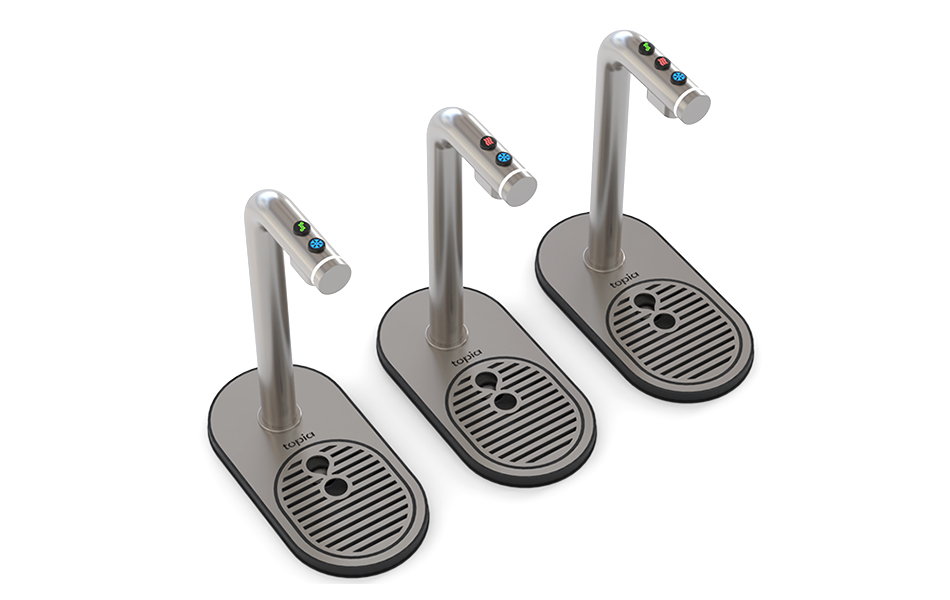
Topia Tap Model Configurations
The Topia Tap range is available in three distinct model configurations to match specific office beverage requirements:
- Topia Tap 402 (Chilled Still & Deep Sparkling): Designed for main office breakrooms and hydration stations focused on cold beverage refreshment. Features an integrated Icebank cooling system capable of delivering 60 liters per hour of continuously chilled still and carbonated water.
- Topia Tap 404 (Chilled Still & Instant Hot): Engineered for coffee stations and team kitchens where hot water for tea, soup, and warm beverages is required alongside chilled drinking water. Combines a 60 L/h cooling unit with a 28 L/h high-capacity boiler.
- Topia Tap 405 (Chilled Still, Deep Sparkling & Instant Hot): The flagship all-in-one commercial solution. Dispenses chilled still, deep sparkling, ambient, and instant boiling water from a single intuitive faucet stem, eliminating the need for separate kettles or countertop sparkling water makers.
Technical Performance Specifications
The following specification matrix provides exact technical parameters required for corporate facilities planning and architectural specification:
| Feature & Specification Parameter | Topia Tap 402 | Topia Tap 404 | Topia Tap 405 |
|---|---|---|---|
| Water Temperature Options | Chilled Still, Sparkling, Ambient | Chilled Still, Hot, Ambient | Chilled Still, Deep Sparkling, Hot, Ambient |
| Chilled Cooling Capacity | 60 Liters / hour | 60 Liters / hour | 60 Liters / hour |
| Boiling Heating Capacity | N/A | 28 Liters / hour | 28 Liters / hour |
| Cooling Technology | Integrated Icebank System | Integrated Icebank System | Integrated Icebank System |
| Maximum Flow Rate | 2.0 Liters / minute | 2.0 Liters / minute | 2.0 Liters / minute |
| Dispensing Height Clearance | 254 mm (Fits sports bottles) | 254 mm (Fits sports bottles) | 254 mm (Fits sports bottles) |
| Tap Dimensions (W x H x D) | 125 x 250 x 304 mm | 125 x 250 x 304 mm | 125 x 250 x 304 mm |
| Cooler Dimensions (W x H x D) | 270 x 437 x 410 mm | 270 x 437 x 410 mm | 270 x 437 x 410 mm |
| Boiler Dimensions (W x H x D) | N/A | 128 x 470 x 320 mm | 128 x 470 x 320 mm |
| Construction Material | Premium Brushed Stainless Steel | Premium Brushed Stainless Steel | Premium Brushed Stainless Steel |
Sub-Micron Multi-Stage Water Filtration Technology
Topia systems attach directly to municipal water supplies, processing water through multi-stage sub-micron filter media to ensure absolute purity and mineral balance:
- High-Performance Particle Fleece: Captures microplastics, rust flakes, silt, and suspended particulate matter down to sub-micron thresholds.
- Ion-Exchange Resin Layer: Selectively reduces carbonate hardness and heavy metal ions (such as lead and copper). This prevents destructive scale accumulation inside the undercounter boiler and cooling block while preserving health-essential minerals.
- Activated Carbon Absorption Block: Absorbs municipal chlorine, organic pesticides, volatile organic compounds (VOCs), and unpleasant odors, ensuring a clean, neutral taste profile.
- Automatic Line Flush Sequence: The system purges residual water from the faucet spout between uses, preventing cross-temperature contamination or lingering effervescence when switching from sparkling to boiling pours.
Facilities & Architectural Specification Blueprint
Integrating a Topia Tap system into a new office build-out or tenant improvement project requires minimal MEP (Mechanical, Electrical, Plumbing) coordination. Facilities managers and interior designers should adhere to the following installation parameters:
Undercounter Spatial and Utility Requirements
To ensure optimal cooling airflow and maintenance access, the undercounter cabinet hosting the Topia Tap processing units must meet these spatial dimensions:
- Minimum Cabinet Enclosure Volume: 900 mm (Width) x 800 mm (Height) x 600 mm (Depth).
- Cabinet Ventilation: Cabinet doors or side panels must include passive ventilation grilles to dissipate heat generated by the Icebank refrigeration compressor.
- Countertop Cutout: Standard 35 mm to 38 mm diameter hole for faucet stem mounting.
| Utility Connection Category | Specification Requirement | MEP Contractor Installation Note |
|---|---|---|
| Cold Water Supply | 1/2-inch isolated cold water feed line | Mains pressure between 3.0 and 4.0 bar static pressure. |
| Electrical Power | Dedicated 220–240V, 50Hz, 13A socket | Located within 1 meter of undercounter units. |
| Waste Water Drainage | 1.5-inch trapped waste pipe or tundish | Connects drip tray overflow line for clean drainage. |
| CO2 Gas Feed (Sparkling) | Food-grade CO2 bottle & dual regulator | Secured vertically inside cabinet with safety bracket. |
