Designing an On-Site Water Bottling Program for Hotel Groups: A Complete Operational, Technical, Evaluation Guide
Designing an On-Site Water Bottling Program for Hotel Groups: A Complete Operational, Technical, and Financial Evaluation Guide
The global luxury hospitality sector faces a decisive operational shift. Environmental legislation, brand reputation pressures, and evolving guest expectations have rendered single-use plastic and imported pre-packaged water obsolete. However, transitioning a multi-property hotel group or a high-occupancy resort to an in-house water bottling program requires far more than placing a countertop dispenser in a pantry. It demands an enterprise-grade infrastructure capable of delivering sub-micron water purity, rigorous thermal sanitization, high-throughput filling during peak seasons, and measurable Total Cost of Ownership (TCO) reductions.
This evaluation guide provides hotel Operations Directors, General Managers, Procurement Leads, and F&B Executives with the technical, operational, and financial framework required to specify, install, and operate a world-class on-site water bottling program.
Explore the Topia Streamline on-site Bottling solutions
2. Core Operational Considerations for Hotel Bottling Programs
When evaluating an in-house water bottling program, hotel leadership must balance five critical operational dimensions to ensure long-term reliability and guest satisfaction.
| Operational Pillar | Key Evaluation Criteria | Technical Requirement |
|---|---|---|
| Volume Profiling | Average daily bottle demand vs peak seasonal headroom. | Must support 1.5x–2.0x peak season surge capacity. |
| Space & Geometry | Footprint limitations and BOH staff circulation routes. | Minimum 9 sqm room footprint; straight or L-shape layout. |
| Thermal Hygiene | Eliminating guest skepticism regarding bottle cleanliness. | 65°C wash and 95°C thermal rinse cycle for total sanitization. |
| Labor Workflow | Minimizing staff labor while maximizing throughput. | 1–2 staff operation; ≤3m 30s wash cycle time per rack. |
| Glass & Capping | Bottle aesthetic, durability, and tamper-evident sealing. | Reusable glass bottles with RipCap, TwistCap, or SwingTop. |
Daily Volume Profiling & Peak Season Demand
Hotel water consumption varies significantly between steady-state occupancy and peak season surges. A 300-room luxury city hotel averaging 1.8 guests per room consumes approximately 600 to 1,000 bottles of water per day across guest rooms, banqueting, executive lounges, and dining outlets. During high-occupancy conference periods or peak summer holiday months, daily volume requirements can double.
Systems must be specified based on peak-hour bottle throughput rather than daily averages. Over-specifying equipment creates unnecessary CapEx overhead, while under-specifying leads to operational bottlenecks, staff overtime, and risk of stockouts during critical guest service windows.
Spatial Footprint & Layout Geometry
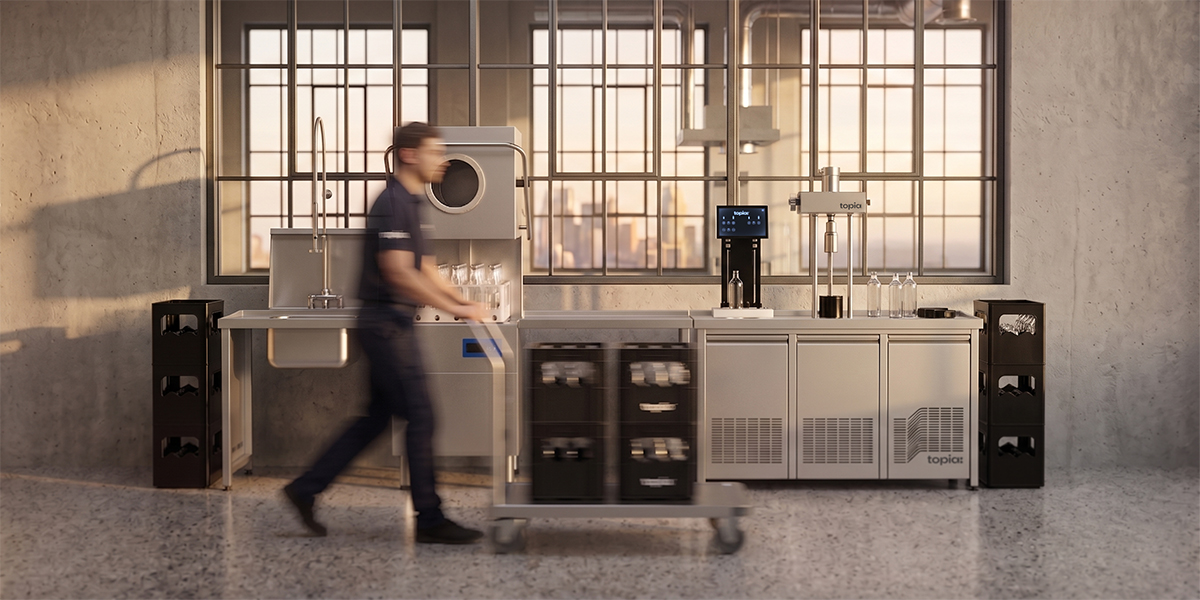
On-site bottling facilities must fit seamlessly into back-of-house (BOH) logistics without disrupting food and beverage pathways. Compact commercial bottling plants, such as the Topia Streamline range, require a minimum room footprint of 9 square meters.
The layout configuration must accommodate a logical, hygienic workflow: dirty bottle receipt and crate staging, pre-rinsing, automated washing, chilled/sparkling filling, capping, labeling, and clean crate dispatch. Systems must offer flexible geometric configurations—specifically straight-line or L-shape modular setups—to fit existing back-of-house store rooms or converted pantries.
Thermal Hygiene & Guest Trust Validation
One of the primary friction points in hotel water bottling programs is staff labor and guest perception regarding bottle cleanliness. To eliminate guest skepticism and guarantee food safety compliance, the washing process must incorporate thermal sanitization.
Commercial bottle washers must utilize a high-temperature wash and rinse sequence. Racks holding 24 bottles (500x500mm rack size) undergo a 65°C main wash cycle followed by a 95°C thermal rinse cycle. This high-heat rinse kills pathogenic bacteria, dissolves organic residues, and thermally sanitizes the interior and exterior of reusable glass bottles without requiring harsh chemical residues that taint water taste.
Labor Efficiency & Workflow Automation
A bottling program should streamline operations rather than increase staff burden. High-efficiency bottling systems are engineered for 1 to 2 dedicated or multi-tasking staff members. Washing cycle times should not exceed 2 minutes per rack, allowing staff to process up to 400–500 bottles per hour depending on automation levels.
Automation features—such as automated filling sensors, pneumatic capping machines, and inline conveyor feeds—drastically reduce manual handling, enabling a small team to handle bottling for an entire 500-room property in a 3-hour daily shift.
Reusable Glass Bottle Ecosystem & Capping Systems
The physical bottle is the primary touchpoint between the hotel brand and the guest. Reusable glass bottles must combine heavy-duty durability for industrial dishwashing with elegant table-side aesthetics.
Topia provides two premium reusable glass bottle designs:
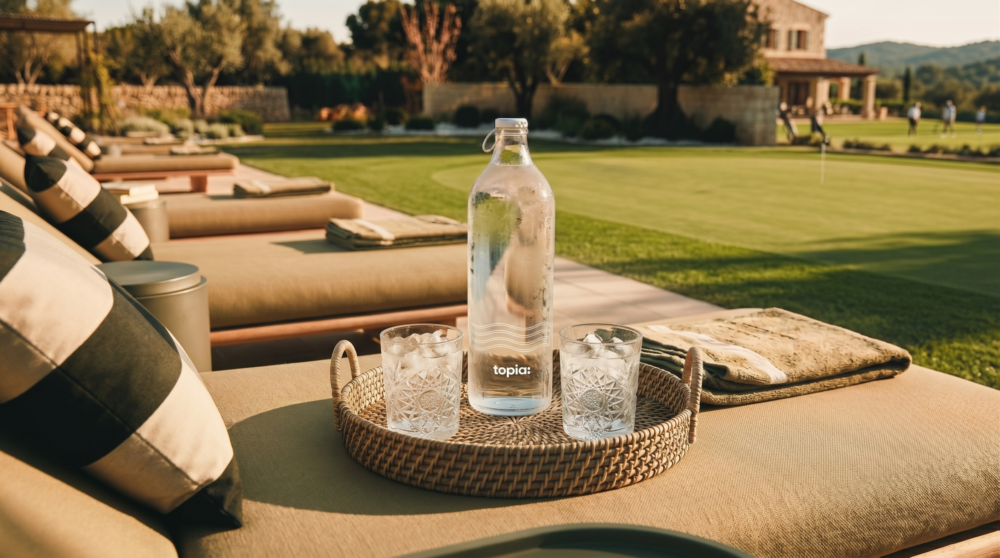
- Urban Rip (500ml & 750ml): Features a single-use aluminium RipCap sealed via manual or pneumatic capping machines. The tamper-evident seal provides guests with visual proof of authenticity and unopened freshness.
3. Technical Systems Evaluation: Topia Streamline 100 vs. Streamline 200
Topia’s Streamline Range is purpose-built for hospitality environments, providing a complete 360-degree on-site bottling ecosystem that combines water purification, chilling, carbonation, bottle washing, filling, and capping.
| Technical Specification | Topia Streamline 100 | Topia Streamline 200 |
|---|---|---|
| Daily Target Capacity | Up to 2,000 guests / bottles | Up to 4,000 guests / bottles |
| Automation Level | Manual & Semi-Automatic | Enhanced Semi-Auto & Auto |
| Wash Cycle Time | 3 minutes 30 seconds | 3 minutes 30 seconds |
| Ambient Throughput | 300 Bottles Per Hour (BPH) | 500 Bottles Per Hour (BPH) |
| Chilled Still Throughput | 250 Bottles Per Hour (BPH) | 500 Bottles Per Hour (BPH) |
| Deep Sparkling Throughput | 250 Bottles Per Hour (BPH) | 400 Bottles Per Hour (BPH) |
| Staffing Requirement | 1–2 Operators | 1–2 Operators |
| Minimum Room Size | 9 square meters | 9 square meters |
| Layout Geometry | Straight-line or L-Shape | Straight-line or L-Shape |
| Wash & Rinse Temps | 65°C Wash / 95°C Rinse | 65°C Wash / 95°C Rinse |
| Electrical Power | 380V (3-Phase), 14kW Max | 380V (3-Phase), 14kW Max |
Topia Streamline 100: Compact Efficiency
The Streamline 100 is engineered for boutique hotels, fine-dining restaurants, and mid-sized properties with daily volume requirements of up to 2,000 bottles.
- Throughput & Output: Delivers 300 BPH ambient, 250 BPH chilled still, and 250 BPH deep sparkling water.
- Workflow: Features a manual or semi-automatic filling head integrated with a bottle washing station and capping station.
- Footprint: Fits comfortably into a 9 sqm room, operating in either a straight or L-shape bench layout.
- Ideal Application: Independent luxury hotels, safari lodges, and properties looking for a compact entry-level commercial bottling plant that minimizes CapEx while maintaining 5-star presentation.
Topia Streamline 200: Enhanced Automated Performance
The Streamline 200 is designed for high-volume city hotels, large resorts, and multi-outlet properties serving up to 4,000 guests daily.
- Throughput & Output: Significantly boosts filling speeds, delivering 500 BPH ambient, 500 BPH chilled still, and 400 BPH deep sparkling water.
- Workflow: Incorporates an automated filling chamber and semi-automatic labeling/capping workflows, accelerating production while maintaining minimal operator intervention.
- Footprint: Maintains a compact 9 sqm footprint, maximizing space efficiency while delivering double the chilled/sparkling output of the Streamline 100.
- Ideal Application: Full-service hotel properties with extensive banqueting facilities, high room counts, and high peak-demand requirements.
Integration with Front-of-House (FOH) Systems
A comprehensive hotel hydration strategy combines BOH bottling plants with FOH point-of-use dispensers:
- Topia Flow Range (Flow 105/205): High-capacity FOH dispensers (90–150 L/h cooling capacity) with dual-filling touchscreens for busy buffet lines, conference breakouts, and executive lounges.
- Topia Touch Range (Touch T2/T4): Sleek, hygienic countertop dispensers (20–60 L/h capacity) ideal for spa areas, gym facilities, and boutique hotel lobbies.
- Topia Tap Range (Tap 400 Series): Space-saving undercounter taps for hotel bars, restaurant dispense bars, and VIP suites.
4. Financial Architecture & Real-World ROI: The Southern Sun Benchmark
Implementing an on-site bottling program replaces an ongoing, volatile OpEx expense (purchasing pre-packaged glass or plastic bottles) with a fixed, highly predictable cost structure that yields substantial financial savings and environmental dividends.
Financial Breakdown: Pre-Packaged vs. On-Site Bottling
Read our case study on the streamline 200
Or request a detailed ROI evaluation for your property.
5. Stakeholder Alignment & Implementation Roadmap
A successful water program requires alignment across the four primary hotel decision-makers:
| Stakeholder Role | Primary Value Driver | Decision Tool / Key Proof Point |
|---|---|---|
| General Manager (GM) | Guest satisfaction, brand perception, risk mitigation, and ESG leadership. | Peer hotel case studies, zero plastic reporting metrics. |
| Operations Director | High throughput, staff efficiency, thermal hygiene, and low downtime. | BOH layout specs (9 sqm), 3m30s wash cycle times, 98% SLA rate. |
| Group Procurement Lead | Total Cost of Ownership (TCO), ROI, contract flexibility, and SLA bounds. | Financial model, cost-per-bottle audit, payback schedule. |
| Food & Beverage Lead | Water taste profile, glass aesthetics, sparkling effervescence, and flow. | Custom bottle engraving, taste profile test, RipCap seals. |
5-Phase Implementation Roadmap
- Phase 1: Water Audit & Volume Profiling (Weeks 1–2)
- Audit current pre-packaged bottle consumption, monthly invoice spend, and peak room occupancy data.
- Determine daily bottle throughput and select between Streamline 100 (up to 2,000 daily bottles) and Streamline 200 (up to 4,000 daily bottles).
- Phase 2: BOH Architectural & Utility Survey (Weeks 3–4)
- Inspect designated 9 sqm room footprint for 380V 3-phase power (14 kW max), mains water connection, drain inlet, and ventilation.
- Finalize bench configuration (Straight-line or L-shape).
- Phase 3: System Fabrication & Custom Bottle Production (Weeks 5–8)
- Manufacture Streamline unit and pre-configure sub-micron filtration and carbonation modules.
- Phase 4: On-Site Installation & Staff Training (Week 9)
- Connect water, power, drainage, and food-grade CO₂ lines.
- Conduct comprehensive operational training for BOH staff covering 65°C/95°C bottle washing, filling, RipCap sealing, and daily hygiene protocols.
- Phase 5: Go-Live & Annual ESG Tracking (Week 10+)
- Commission system for full guest-facing distribution.
- Track liter counts to generate annual Topia Impact Reports detailing exact plastic bottle elimination, CO₂ savings, and net financial ROI.